Execution Order and Algebraic Loops
Overview
Before the simulation loop starts, pySimBlocks determines the order in which
blocks must call output_update() at each step. This order is computed once
during the compilation phase and reused at every tick.
The ordering problem reduces to a single question: for a given block, have all its upstream blocks with direct feedthrough already computed their output at this step? If not, the block would read a stale input — which is incorrect.
A block has direct feedthrough if its output at step k depends on its input at
the same step k — i.e. u[k] appears in output_update(). See
Block Model for how direct_feedthrough is declared in practice.
If a dependency cycle exists between blocks with direct feedthrough and no
stateful block breaks it, the order cannot be resolved. This is an
algebraic loop and pySimBlocks raises a RuntimeError before the
simulation starts.
Building the execution order
Direct feedthrough graph
Not all signal edges constrain execution order. Only edges where the destination block has direct feedthrough create a dependency: the source must compute its output before the destination can compute its own.
pySimBlocks builds a directed graph containing only these edges, then sorts
it topologically. Blocks without direct feedthrough — like Delay — are
ignored in this graph and can execute in any order.
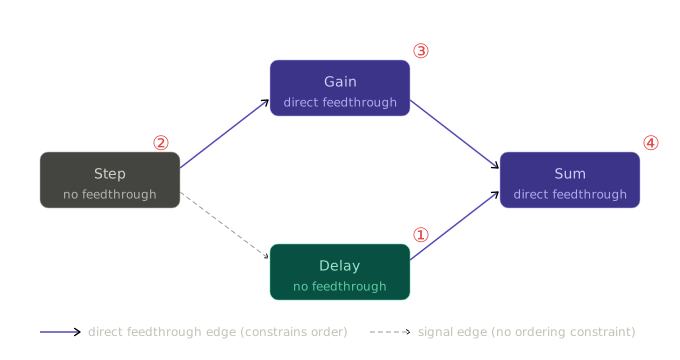
In this example, Delay and Step have no ordering constraint between them.
Delay is placed first arbitrarily. Gain must follow Step (it reads
Step’s output directly), and Sum must follow both Gain and Delay.
Topological sort
pySimBlocks uses Kahn’s algorithm. It starts from all blocks with no incoming direct-feedthrough edges (indegree = 0) and processes them one by one, decrementing the indegree of their successors. A block is added to the execution order as soon as its indegree reaches zero.
For the example above:
Step |
Ready queue |
Executed |
|---|---|---|
init |
Delay, Step |
— |
1 |
Step |
Delay ① |
2 |
Gain |
Step ② |
3 |
Sum |
Gain ③ |
4 |
— |
Sum ④ |
The order between blocks with indegree 0 at the same time (here Delay
and Step) is non-deterministic and may vary between runs.
Algebraic loop
What is an algebraic loop?
An algebraic loop occurs when two or more blocks with direct feedthrough form a cycle in the dependency graph. Block A needs B’s output to compute its own, and B needs A’s output — neither can go first.
A simple example: a Sum block whose output feeds back into itself through
a Gain, with both having direct feedthrough and no stateful block breaking
the cycle.
model.connect("sum", "out", "gain", "in")
model.connect("gain", "out", "sum", "in1")
This is mathematically an implicit equation y = f(y) that pySimBlocks
cannot resolve in discrete time without a delay or a stateful block.
How algebraic loops are detected and reported
Kahn’s algorithm detects the loop naturally: if after processing all blocks with indegree 0 some blocks remain unprocessed, it means they are part of a cycle. pySimBlocks raises immediately:
RuntimeError: Algebraic loop detected: direct-feedthrough cycle exists.
This error is raised during the compilation phase, before initialize() is
called. The fix is always one of:
Insert a
Delayblock to break the cycle.Replace a direct-feedthrough block with a stateful equivalent (e.g.
DiscreteIntegratorin Euler forward mode).
Stateful blocks as cycles breakers
A block breaks a cycle only if it has no direct feedthrough. In that case,
output_update() only reads x[k] — the state from the previous step —
so its incoming signal edges are not direct-feedthrough edges and do not
appear in the dependency graph.
Even if block A feeds block B which feeds back into A, if A has no direct feedthrough the dependency graph has no edge B → A, and the cycle disappears.
This is exactly how Simulink handles algebraic loops, and pySimBlocks follows the same convention.
Note
A stateful block with direct_feedthrough = True (e.g. DiscreteIntegrator
in Euler backward mode) does not break cycles — its incoming edges are
still in the dependency graph.